

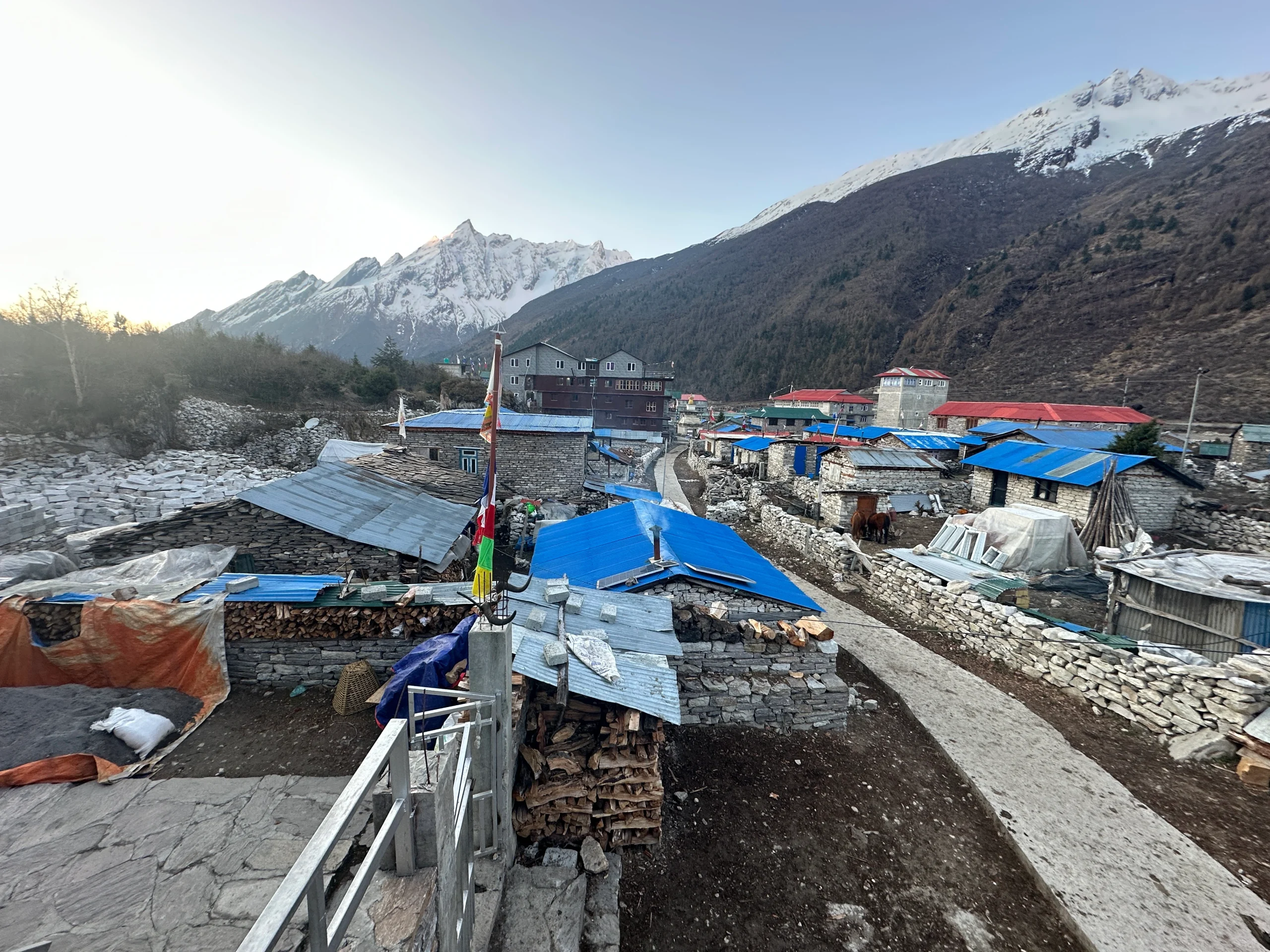
The hike from Samagaun to Manaslu Base Camp is definitely one of the most beautiful side-trips in the Manaslu Circuit Trek. This is generally done on the acclimatization day before crossing the challenging Larkya La Pass(5,106 m).
Starting from Samagaun (3,530 m), the path gradually climbs to Manaslu Base Camp (4,800 m). The round trip covers about 12–15 km and usually takes 7–9 hours. Although the terrain is not difficult, the steep rise and high altitude make it the most strenuous day’s walk on the journey.
On a single day, there will be a rapid elevation of roughly 1270–1,300m. A decent level of fitness is required because of the thin air at nearly 4,800 meters.
If you are planning the Manaslu Circuit Trek, you may be wondering whether this side trip is worth the extra effort. This guide includes details on the hiking trail, distance, elevation, permits, best time to visit, safety precautions, and a recommended itinerary to help you decide.
What Is Manaslu Base Camp?
Manaslu Base Camp is the main campsite for climbers attempting to summit Mt. Manaslu (8,163 m), the world’s eighth-highest mountain. It is situated at an elevation of approximately 4,800 meters (15,750 ft) on the southern flank of Mt. Manaslu. The Manaslu Expedition group does a rotation of Camp I, Camp II, and Camp III from Base Camp before heading for the summit push.
For trekkers, Manaslu Base Camp is a side trip and acclimatization hike, so they don’t spend the night here. You hike from Samagaun, spend some time in Manaslu Base Camp, and descend back to Samagaun. You will follow the golden acclimatization rule: “climb high, sleep low.”
Samagaun, also called Sama Gaon or Samagaon, is the last major village before the high mountains. The village sits at 3,530 meters in the Nubri Valley of Gorkha District. It is a centuries-old settlement with a strong Tibetan Buddhist culture. Most trekkers spend two nights here for acclimatization. One day is reserved for the hike to Manaslu Base Camp. Afterward, the trek continues to Samdo and Larkya La Pass.
Quick Facts: Samagaun to Manaslu Base Camp
| Detail | Information |
| Starting point | Samagaun Village, 3,530 m (11,580 ft) |
| Ending point | Manaslu Base Camp, approximately 4,800 m (15,750 ft) |
| Round-trip distance | 12–15 km |
| Elevation gain | Approximately 1,270–1,300 m |
| Duration | 7–9 hours (round trip, including rest breaks) |
| Difficulty | Strenuous day hike, but non-technical |
| Overnight required? | No – it is a day hike. Trekkers return to Samagaun for overnight stay. |
| Best months | March–May (Spring) and September–November (Autumn) |
| Permits needed | Restricted Area Permit (RAP), Manaslu Conservation Area Permit (MCAP), and Annapurna Conservation Area Permit (ACAP) |
| Guide required? | Yes, a licensed guide is mandatory by law |
| Typical trek position | Day 7–9 of a 14–18 day Manaslu Circuit Trek itinerary |
Why Trek From Samagaun to Manaslu Base Camp?
Unlike the popular and most visited Everest Base Camp(EBC) Trek and Annapurna Circuit, the Manaslu Region sees very few trekkers. The reason is due to its less commercialized and restricted status. The trails here remain quiet even in the popular trekking season. The authentic teahouses, untouched natural beauty, and beautiful Himalayan views can be experienced without sharing with hundreds of other hikers.
The hike itself delivers:
- Close-up views of Mt. Manaslu (8,163 m) and neighboring peaks include Himalchuli (7,893 m) and Ngadi Chuli(7,871 m).
- Glacial scenery – you walk alongside the Manaslu Glacier and past Birendra Lake, a turquoise glacial lake fed by icefall from the mountain
- A genuine acclimatization function – this isn’t a detour for the sake of a detour; hiking high and sleeping low here directly reduces your risk of altitude sickness before you tackle the 5,106 m Larkya La Pass a few days later.
- Access to mountaineering culture – during September to November, the base camp area is active with real Manaslu summit expeditions, so you may pass climbers, high-altitude porters, and expedition camps preparing for a summit push.
The Route: What the Trail Actually Looks Like
From Samagaun, the trail heads north out of the village, initially along a relatively gentle path through yak pastures and past mani walls. These mani walls are carved with Buddhist prayers and mantras.
Within the first hour of the hike, you’ll reach Birendra Lake (also called Birendra Tal), a glacial lake at around 3,700 m named after Nepal’s former King Birendra. Many trekkers treat this as a worthwhile stop even on its own, with the lake reflecting the surrounding peaks and the Manaslu icefall visible in the distance.
Beyond the lake, the trail steepens noticeably. You’ll cross moraine, loose scree, and rocky terrain as you gain altitude. There’s no technical climbing involved – which means there will be no ropes, no crampons required. However, the combination of thin air and a steep, unstable trail surface makes the final stretch the hardest part of the day.
Around 4,300 m, most visitors stop for a longer break before the final push. At this height, even a short hill section is extremely exhausting due to the effects of high-altitude.
The last 500 vertical meters to Manaslu Base Camp(MBC) are the steepest and slowest sections. As you climb higher, the view of Manaslu Glacier is revealed. The final walk to the 4,800m viewpoint is a rocky trail which might be covered by snow during the shoulder season.
Upon reaching Base Camp, the stunning 360-degree panorama of the Manaslu Massif, Himalchuli, and the glacial valley below will treat you. Most of the trekkers spend around 45 minutes – 1 hour resting, taking pictures and feasting their eyes with natural beauty.
Then, after spending a wonderful time here, it’s time to go back to Samagaun. It takes around 2-3 hours to get back to the teahouse of Samagaun. The descent is easier on the lungs but harder on the knees; therefore, we recommend using trekking poles.
Sample Hour-by-Hour Itinerary
Here’s a realistic timeline for the day, assuming an early morning start from Samagaun:
| Time | Activity | Elevation |
| 6:30–7:00 AM | Breakfast and departure from Samagaun | 3,530 m |
| 7:00–8:30 AM | Walk to Birendra Lake, brief stop | 3,700 m |
| 8:30–10:00 AM | Steady ascent through moraine and rocky trail | 3,700–4,300 m |
| 10:00–10:30 AM | Rest break — hydrate, snack, acclimatize | 4,300 m |
| 10:30 AM–12:00 PM | Final steep push to base camp | 4,300–4,800 m |
| 12:00–1:00 PM | Time at Manaslu Base Camp — photos, rest, views | 4,800 m |
| 1:00–3:00 PM | Descent back to Samagaun | 4,800–3,530 m |
| 3:00 PM onward | Rest, meal, and recovery at Samagaun teahouse | 3,530 m |
Note: Trekkers who find high-altitude hiking challenging should consider taking a hike to Birendra Lake. But for those who love the challenge and are comfortable walking at high altitude, they can hike to MBC. Always select the hike according to your fitness level and comfort with altitude.
Difficulty Level: Who Can Do This Hike?
Although the most difficult part of the entire Manaslu Circuit Trek is crossing Larkye La Pass(5,106 meters), the hike to Manaslu Base Camp is surprisingly difficult. Here are the top reasons why it’s harder than expected:
- Steep climb in a single day: You usually start from Sama Gaun(~3,530 m) and gain 1,200–1,400 m of elevation in one out-and-back hike.
- Already at altitude: Even before you start, you’re sleeping above 3,500 m, so recovery is slower, and breathing is harder.
- Continuous uphill: Much of the route is a sustained climb with fewer long flat sections than many trekkers expect.
- Same-day descent: After reaching the Base Camp, you need to descend all the way back to Sama Gaun before evening. No other option is available as there are no teahouses or campsites at the base camp for trekkers.
- Thin air: The oxygen you breathe is nearly 55-60% at 4,800 than at sea level, which makes the body and mind tire quickly.
- Temperature swings: At high altitude, the temperature in the early morning remains near freezing, while midday the sun is intense.
Note: Trekkers who find high-altitude hiking challenging should consider taking a hike to Birendra Lake. But for those who love the challenge and are comfortable walking at high altitude, they can hike to MBC. Always select the hike according to your fitness level and comfort with altitude.
Best Time to Trek to Manaslu Base Camp
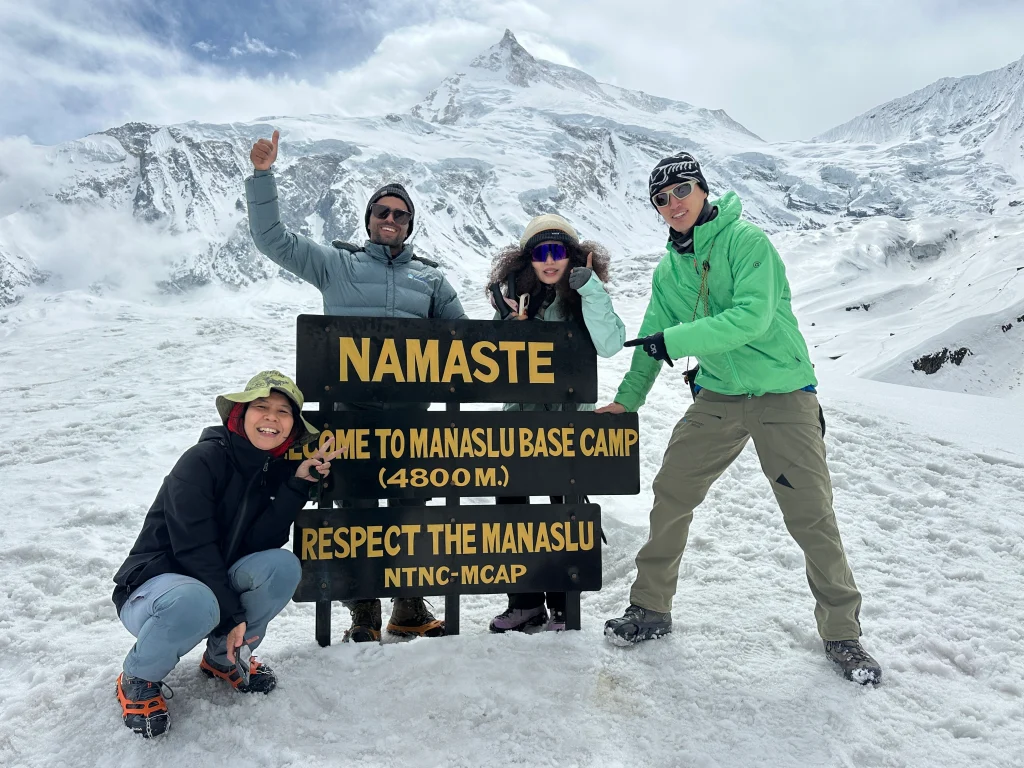
Autumn (September–November) — Generally considered the best window.
During Autumn, the sky remains clear most of the time, and visibility of mountain peaks remains better than in spring. Autumn is also the season when climbers head for the Manaslu expedition. During this time, you can see colorful tents active at Base Camp, adding energy to the atmosphere. The only downside of this season is that the permit cost is a little higher, in this season and trail remains of Samagaun remains busy.
Spring (March–May) – Popular Season
Spring is the season for blooming. The trails become colorful with wildflowers and the vibrant color of Rhododendron flowers in the forest area. The temperature is moderated during this time, but visibility is not consistent like in Autumn. Also the chances of occasional rainfall can affect the lower trail, but the high trail to base camp itself is rarely affected.
Winter (December–February)
The Manaslu trek in the winter is possible but very rare due to cold temperatures, heavy snowfall at high altitude and poor visibility. Also, some of the teahouses might not fully operate due to lack of tourist visits. The best part is that permit fees are lower during this window.
Monsoon (June–August)
Trekking agencies usually don’t recommend trekking inside Nepal during the monsoon due to heavy rainfall and leeched on lower forest trails. Also, poor visibility, sudden changes in temperature and risk of natural disasters during this time make it less favorable for the MBC hike.
Permits Required
The Manaslu region is a restricted area due to its sensitive border location. It means you cannot simply show up and walk in. To participate in trekking, permits are arranged through a registered Nepali trekking agency. Then only can you legally trek with a licensed guide.
Three permits cover the Samagaun–Manaslu Base Camp section as part of the wider Manaslu Circuit:
- Manaslu Restricted Area Permit (RAP) – the primary permit for the controlled zone between Jagat and Dharapani (which includes Samagaun). Cost varies by season:
- September–November: USD 100 for the first 7 days, plus USD 15 per additional day
- December–August: USD 75 for the first 7 days, plus USD 10 per additional day
- Manaslu Conservation Area Permit (MCAP) – a flat fee of roughly USD 30 (NPR 3,000) for foreign trekkers, valid year-round.
- Annapurna Conservation Area Permit (ACAP) – required if your itinerary continues over Larkya La Pass into the Annapurna Conservation Area, roughly USD 30.
A small local development fee (around NPR 1,000, collected by the Chum-Nubri Rural Municipality) is also typically paid on the trail near Jagat or Philim.
Important 2026 update: Until March 2026, Nepal required a minimum of two foreign trekkers to jointly apply for a Manaslu Restricted Area Permit, which effectively priced out solo travelers unless they paid for a “ghost” second permit.
As of March 22, 2026, the Department of Immigration removed that requirement, so solo foreign trekkers can now apply individually. A licensed guide is still mandatory regardless of group size – this has not changed, and there is no way to trek the Manaslu region independently without one.
A TIMS card is not required for this route, since the Restricted Area Permit already serves that registration function.
What This Trek Costs
Samagaun to Manaslu Base Camp hike is never done as a standalone budget trip – it’s always part of a broader Manaslu Circuit itinerary. Therefore, we need to budget for the full 12- 18-day Manaslu Circuit trek Package that include Base Camp hike:
Expense category | Approximate cost (USD) |
Permits (RAP + MCAP + ACAP + local fee) | $150–$300 |
Licensed guide | $30–$35/day |
Porter (optional) | $20–$25/day |
Teahouse lodging + meals | $30–$40/day |
Kathmandu–trailhead transport (round trip) | $100–$650 depending on bus vs. private jeep |
Total package (guided group trek) | $999–$1500+ |
Total package (private/customized trek) | $1,500–$2,800+ |
Note: If you are a solo trekker, you can join the group departure date by checking with the tour operator. Trekking agencies usually offer the group discount in packages.
Where to Stay and Eat in Samagaun
Samagaun is the largest and most developed village in the Manaslu Region trekking route, with a cluster of teahouses compared to other villages such as Samdo or Dharamsala.
Expect:
- Basic but comfortable teahouse rooms, usually twin-share with shared bathrooms.
- Standard trekking menus: dal bhat, noodle soups, momos, porridge, and basic Western options like pancakes or fried potatoes.
- A well-equipped health post in the village capable of treating altitude sickness (including HACE and HAPE) and even providing supplemental oxygen — one of the better-equipped medical posts on the entire circuit.
- Limited mobile network coverage and basic paid WiFi/internet available at some lodges.
Most itineraries schedule two nights in Samagaun: one general acclimatization night, and one built specifically around the base camp hike day.
Other Things to Do in Samagaun
If you have the extra day (and most itineraries build one in for acclimatization), pair the base camp hike with these nearby highlights:
- Pungyen Gompa – an 18th-century Buddhist monastery about 16 km from Samagaun, framed by views of Manaslu and Himalchuli, and considered a spiritual highlight of the region
- Birendra Lake – the glacial lake you’ll pass en route to base camp anyway, worth lingering at for photos of the reflected peaks
- Samagaun village itself – traditional stone houses over a century old, mani walls, and a strong living Tibetan Buddhist culture practiced by the local Nubri people, who celebrate festivals like Lhosar (Tibetan New Year)
Altitude Sickness and Safety
At 4,800 m, altitude is the single biggest risk factor on this hike, not the terrain. Here are helpful tips to remain safe during the hike:
- Acclimatize before you attempt it. Nearly every itinerary places this hike after 5–6 days of gradual ascent from lower villages. Don’t attempt to rush straight to Samagaun and hike to base camp without that buildup.
- Hydrate aggressively. Dehydration triggers altitude sickness symptoms.
- Walk slowly and steadily, especially on the final 500 m push – this is not a hike to rush.
- Know the warning signs of Acute Mountain Sickness (headache, nausea, dizziness, loss of appetite) and tell your guide immediately if you experience them.
- Descend if symptoms worsen. The “climb high, sleep low” structure of this hike exists precisely so you get high-altitude exposure without sleeping at that altitude, which is the safer way to acclimatize.
- Travel insurance matters. As of 2026, proof of travel insurance covering high-altitude trekking and helicopter evacuation is checked alongside your permits at entry gates. Make sure your insurance policy covers all these things up to 5,000m and 6,000m.
- Samagaun’s health post is one of the better-resourced facilities on the route and can administer supplemental oxygen if needed. But for serious cases, descent or helicopter evacuation is required.
What to Pack for the Base Camp Day Hike
No need to have the expensive gear of full mountaineering equipment for this standard hike. However, we need to be ready by preparing ourselves for rapidly changing weather conditions by carrying trekking clothes and equipment.
What to carry with you:
- Sturdy, broken-in trekking boots with good ankle support
- Trekking poles (strongly recommended for the loose scree on the descent)
- Layered clothing – a warm insulated jacket, windproof/waterproof shell, thermal base layers
- Sun protection: sunglasses (glacier glare is real), sunscreen, and a hat
- Gloves and a warm hat for the exposed upper sections
- 2–3 liters of water
- High-energy snacks (nuts, energy bars, dried fruit)
- A basic first-aid kit and any personal altitude medication prescribed by your doctor
- Camera or phone with a spare battery (cold drains batteries fast at altitude)
Is Manaslu Base Camp Worth It Before Larkya La?
Some trekkers often believe that completing the Manaslu Base Camp before crossing the Larkya La Pass is worth visiting. Only a few trekkers skip the hike and continue toward the Manaslu Circuit trek journey.
While others use the Base Camp hike as acclimatization before pushing on to Samdo, Dharamsala, and eventually crossing the Larkya La Pass(5,106 m). It is one of the most demanding high mountain passes in the Himalayas. After crossing the pass, you will descend to the Annapurna Region and exit via Dharapani or Besishar.
Frequently Asked Questions
How difficult is the Samagaun to Manaslu Base Camp hike?
It is a strenuous, non-technical day hike rated as moderate to hard depending upon the fitness level. Trekkers defined this hike as the toughest day hike in the Manaslu Circuit due to a combination of 1200m + elevation gain, steep rough terrain, and thin air at 4,800 meters.
Do I need a guide for this hike?
To trek inside the Manaslu Region, which is listed as a restricted area by the government of Nepal by law, all trekkers need to hire a licensed guide. The Hiring Guide applies whether you are trekking solo or in a group.
Can I do this as a day trip without the full Manaslu Circuit?
To reach Samagaun itself, it takes several days, so the Base Camp hike is not a single-day hike but a part of the multi-day Manaslu Circuit trek.
How high is Manaslu Base Camp?
Manaslu Base Camp is located at an altitude of 4,800 meters (15,750 ft).
Is altitude sickness a serious risk on this hike?
Yes, the risk of altitude sickness remains high on this hike because the journey starts from Samagaun(3,530 m). The rapid elevation gain to reach Base Camp 4,800 meters of around 1200m+ significantly increased altitude sickness(AMS). A proper acclimatization plan such as hydration, slow packing, and taking enough rest is required to prevent AMS.
What permits do I need?
A Manaslu Restricted Area Permit (RAP), a Manaslu Conservation Area Permit (MCAP), and an Annapurna Conservation Area Permit (ACAP) are required. A TIMS card is not required.
Can solo trekkers do the Manaslu Circuit now?
Yes. As of March 22, 2026, Nepal’s Department of Immigration removed the requirement for a minimum of two trekkers to jointly apply for a Restricted Area Permit, allowing solo foreign trekkers to apply individually. A licensed guide is still mandatory.
When is the best time to hike to Manaslu Base Camp?
Autumn (September–November) offers the clearest skies and highest success rate for good mountain views, though it’s also the busiest and most expensive season for permits. Spring (March–May) is a strong alternative with milder weather and rhododendron blooms.
How long does the round trip take?
On average, it takes 7-9 hours, including rest breaks, covering a 12–15 km round-trip distance from Samagaun.
Where do I sleep – at base camp or back in Samagaun?
There are no teahouses at Base Camp, so after reaching the Base Camp, you need to return to Samagaun for an overnight stay.
Final Thoughts
The primary goal to reach the Manaslu Base Camp(MBC)p is to enjoy the close view of Mt. Manaslu. Although the hike to MBC is challenging, the hard and honest day of walking rewards you with close-up views of glacial lakes, Manaslu, and remote beauty that is difficult to find in other trekking routes. It’s like a hidden gem that few trekkers have reached.
If you are planning to do the Manaslu Circuit trek with a hike to Manaslu Base Camp, then Peaceful Nepal will organize the trip for you. We are a local tour operator and specialize in organizing safe Himalayan adventures in Nepal. For more details, contact us through email (info@peacefulnepal.com) or Whatsapp(+9779851150739 ).
Posted on