

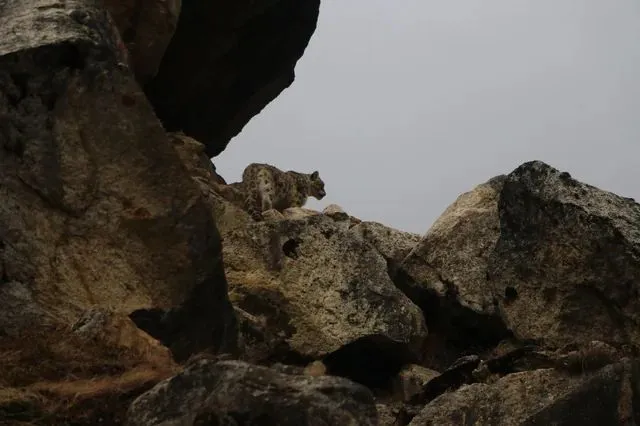
High in the cold and rocky Himalayas, a rare and beautiful animal lives quietly among the cliffs—the snow leopard. It moves silently, lives alone, and is perfectly adapted to survive in one of the harshest places on Earth.
In April 2025, Nepal shared very important news. The country is now home to about 397 snow leopards, with an estimated range between 331 and 476 individuals. This means Nepal protects nearly 7–10% of the world’s total snow leopard population, making it one of the safest places for this endangered species.
Nepal’s first national snow leopard survey gave us this number. Scientists used camera traps and DNA testing on scat (poop) that was collected from 2015 to 2024. Experts were able to get more accurate data than ever before thanks to these new methods. There are about 1.56 snow leopards per 100 square kilometres in most high-mountain areas.
Nepal has also started a new plan to protect snow leopards from 2024 to 2030. The main goals of this plan are to work with local communities, protect habitats, and reduce the amount of conflict between people and animals. It shows that people and snow leopards can live in peace.
For nature lovers and trekkers, this news is special. It means Nepal’s high mountains are still wild and alive. When you walk through these remote landscapes, you are sharing space with the “ghost of the mountains”—a symbol of hope for wildlife conservation in the Himalayas.
If you are planning to visit Nepal to spot the snow leopard for photography, this blog post will guide you with everything you need to know. You will learn how to see the rare “ghost of the mountains” more often while being respectful of nature and the people who live there. This includes the best places and times to go, as well as expert tips.
Why Snow Leopards Are So Hard to Find
- Invisibility: The snow leopards in Nepal are difficult to spot due to their grey-white fur blends perfectly with snowy mountains, rocky cliffs, and high-altitude landscapes.
- Low Density: The total population of snow leopards in Nepal is low, and they are scattered among different Himalayan regions of Nepal. Because they are naturally few in number and live in large territories, the chance of spotting one in the wild is very rare.
- Nocturnal & Crepuscular: During the day, snow leopards usually sleep and hide among rocks. They hunt outside, especially in the early morning, late evening, and at night.
- Remote Habitat: They like to live in places that are hard to get to and far away from people. People can’t easily get to the places where snow leopards live, like high mountains that are between 3,000 and 6,000 meters above sea level.
Spotting a Snow leopard in Nepal is pure luck. Why? Because snow leopard spotting is not guaranteed. However, the trekking trails in Nepal have a record of sightings, as they are located inside the National Park or Conservation Area. Also, the trekkers can get reliable infrastructure during the visit.
Trekking Regions Where Snow Leopards Have Been Documented
Annapurna Conservation Area (ACA) – The Annapurna Circuit & Nar Phu Valley
| Sub‑region | Elevation (m) | Typical Trek Duration | Notable Snow Leopard Hotspots |
| Annapurna Circuit Trek | 4 000–5,416 m | 12–16 days | Manang village, Yak Kharka, Ledar, and Thorong Phedi |
| Nar Phu Valley Trek | 5,300-5,320 meters | 11-14 days | Kang La Pass, Lho and Sama Gaon |
Why It Works: Annapurna Conservation is Nepal’s largest protected zone (7,629 sq km), popular for its rich biodiversity. During the trek in this region, you need to cross the alpine meadows, glacier‑fed streams, and steep cliffs( prime snow leopard hunting grounds). You can hear local Sherpa-Mongol herders’ stories about sightings of snow leopards. Also, as per the ACA monitoring program, there is a record of over 30 confirmed signs (tracks, scat) in the past five years.
Manaslu Conservation Area- Manaslu Circuit, Tsum Valley & Manaslu Base Camp
| Sub‑region | Elevation (m) | Typical Trek Duration | Notable Snow Leopard Hotspots |
| Manalsu Circuit Trek | 4,800m-5,106m | 12–18 days | Larkya La Pass, Dharamsala, Samagaon, and near Birendra Lake |
| Tsum Valley Trek | 3,000m-3,700m | 14-16 days | Chhekampar (including Somdanda, Dadhlan Chaur) and Chumchet |
| Manaslu Base Camp Trek | 4700-4895m | 12 to 18 days | Samagaon, Birendra Lake, and the higher reaches towards Larkya La Pass |
Why It Works: Manaslu Conservation Area, located in Northern Gorkha District, bordering Tibet, is a remote trekking destination and a less crowded area. Blue sheep and Himalayan tahr are commonly seen here, so it is a hunting place for snow leopards. MCA has recorded multiple signs of snow leopard activity, and there is also a video of trekkers on YouTube who capture snow leopards.
Langtang National Park – Langtang Valley & Helambu Trek
| Sub‑region | Elevation (m) | Typical Trek Duration | Notable Snow Leopard Hotspots |
| Langtang Valley Trek | 3,870m-4,984m | 7–10 days | above Kyanjin Gompa, especially towards Tsergo Ri |
| Helambu Trek combined with Langtang and Gosaikunda | 4,600m-4,984m | 15 to 18 days | Gosaikunda (Laurabina La Pass area), and Shivapuri National Park (part of the route)village, high‑pasture of Yala. |
Why It Works: Langtang National Park is home to diverse wildlife such as Red pandas, musk deer, Himalayan tahr, and snow leopard. The Nepal Snow Leopard Trust, in collaboration with Nepal’s NTNC, has installed camera traps at various locations, often near prey habitats, to capture the snow leopard.
Sagarmatha National Park – Everest Region
| Sub‑region | Elevation (m) | Typical Trek Duration | Notable Snow Leopard Hotspots |
| Everest Base Camp (EBC) Trek | 3,000m to 5,164 m | 12–14 days | Thame Valley |
| Gokyo Valley Trek | 4,000 m-5,000m+ | 10–12 days | Machhermo, Phortse Thanga, and the high slopes above Thore/Thare, |
| Everest Three Passes Trek | 5,364m-5,535m | 17 to 21 days | Kongma La Pass, Renjo La’s Pass and near Cho La Pass |
Why It Works: There are a few snow leopards living on the high-altitude plateau around Gokyo and the steep rocky ridges above Lobuche. These cats often walk along the same paths that hikers do, which makes it more likely that you will see them. Near Pheriche, conservation groups have set up Snow Leopard Observation Posts where local guides tell visitors about the latest sightings and other information.
Dolpo Region – Upper Dolpo & Shey Phoksundo National Park
| Sub‑region | Elevation (m) | Typical Trek Duration | Notable Snow Leopard Hotspots |
| Upper Dolpo Trek | 5,360m-5,550m | 20–30 days (remote) | Shey Gompa, Nangdalo Base Camp (Perikopa area), and Bhijer |
| Shey Phoksundo National Park | 2 900–5 400 | 12–18 days | Phoksundo Lake’s rim, Bhotekoshi gorge. |
Why It Works: Recent camera trap surveys in Dolpo found plenty of snow leopards, both inside and outside of the protected Shey-Phoksundo National Park. One study found about 90 snow leopards in the park, and another estimated 30 snow leopards in the areas around the park. This means that there are about 120 snow leopards in Dolpo, which is the most in any part of Nepal.
Best Time to Hunt (Spot) Snow Leopards in Nepal
The best time to see or take pictures of snow leopards in Nepal is during the winter (from December to March). During this time, snow leopards follow their prey down to lower elevations, which makes it a little easier to see them. The cold, clear weather makes it easier to see in the mountains. There are fewer tourists on treks, which means snow leopards can move around more freely.
Time of Day: Snow leopards are most active in the early morning, late evening, and at night. You can see their movement, tracks, or signs best in the early morning and late afternoon.
Tip: Be patient. Snow leopards are hard to find, and even in the best places, you don’t see them very often. Seeing signs like tracks, scat, and markings can also make your time enjoyable.
How to Maximise Your Chances (and Keep the Cats Safe)
- Hire a Certified Snow Leopard Guide and naturalists – Some of the trekking agencies in Nepal provide locally renowned guides and naturalists who are experts in snow leopard tracking. These experts know the best areas to find signs of snow leopards, understand their behavior, and can help you spot them while remaining safe and maintaining distance.
- Stay on Designated Trails – If you are planning for the Snow leopard tracing in Nepal, we recommend that you stick to marked trails. Avoid disturbing snow leopards or other animals in the area.
- Carry a Pair of Binoculars (8×42) – For a clear view and to spot from a distance, make sure to carry high Magnification, good quality Binoculars.
- Use a Camera with a Tele‑Zoom (≥300 mm) – Flash can startle cats; a silent, high‑ISO sensor works best in low light.
- Observe the “Leave No Trace” Principle – When you are travelling in the Himalayas region and remote regions, we suggest you follow the Leave No Trace Principles. Also, avoid loud noise while visiting the wildlife areas in the Himalayan region.
- Respect Local Communities – Snow leopards are spotted near the ruler village, so while visiting this local region, make sure to respect their local culture and traditions.
- Report any Sighting – IF you spot any snow leopard in Nepal, make sure to report to the National Trust for Nature Conservation (NTNC) or the Snow Leopard Trust with photo, time and place. It will help to maintain the record and data of snow leopards for monitoring.
Visa, Permits & Logistics
Nepal Visa: To enter Nepal, all travellers must have the Nepal Visa, which you can obtain either in advance from your home country or at Tribhuvan International Airport as an arrival visa. Visa cost depends on the number of days you wish to spend here. For 15 Days cost: 30 USD, for 30 Days Cost: USD 50, for 90 days Cost: USD 125.
Permits: Most of the high altitude treks in Nepal lie inside the National Park, Conservation Area or Protective Areas. To enter this region, you might need to obtain the permits. So make sure to obtain all the required permits before you travel in this region. Travelling without permits is illegal, and you might face legal consequences.
Travel tip: If you want to trek or spot snow leopards in Nepal, it’s best to book your trip with a reputable tour operator. They often offer the package that includes food, accommodation, guides, porters and other logistics to make the trip easier and fun.
Insurance: For adventurous activities and visiting the high altitude region, we highly recommend that you purchase travel and health insurance that covers travel risk, including emergency helicopter evacuation.
Conservation Corner – Your Trek Helps Save the Snow Leopard
- Community‑Based Conservation: 70 % of all snow‑leopard monitoring in Nepal is carried out by local herders trained as “Snow Leopard Guardians.” By trekking with licensed guides, you directly support these income‑generating programs.
- Anti‑Poaching Patrols: Trekking groups that contribute a small “conservation levy” (≈ 500 NPR per person) fund year‑round patrols in the high‑altitude park zones.
- Research Collaboration: Camera‑trap images you help locate are uploaded to the Global Snow Leopard & Ecosystem Protection Program (GSLEP), helping scientists model population trends across the Himalaya.
Frequently Asked Questions
Can I see a snow leopard on a day trek?
It’s rare because snow leopards inhabit high-altitude areas(≥ 4,500 m), and to reach these places, you need to trek for several days.
Do I need a special wildlife‑viewing license?
No, you don’t need a special wildlife-viewing license, but depending upon the location, you might need to obtain the permits.
What should I do if I encounter a snow leopard?
The first thing you should do is remain calm and avoid any movements so that you will not scare the snow leopard. Try to maintain a safe distance and never try to photograph at close range for safety.
Are there any health risks at 5,000 m?
In Nepal altitudes of around 5,000m, there is a high risk of altitude sickness(AMS). So if you are travelling at high altitude in Nepal for snow leopard sightseeing, make sure to learn AMS symptoms and preventive measures. You can also take Diamox( altitude sickness medicine) after consulting a doctor.
Is it safe to trek alone?
Travelling in remote and high-altitude regions is not recommended for solo travellers. Therefore, always hire a licensed guide as your travel partner and book your trip through a local trekking agency.