

Introduction: Where the Lowlands Surrender to the Mountains
If you’re planning an adventure in the Annapurna region of Nepal, there’s one town you just can’t miss – and to be honest, you won’t be able to. Chhomrong is situated high on a ridge above the raging Modi Khola river, and is more than just a place to rest your weary legs; it is the beating heart of the Annapurna Sanctuary trek.
Whether you’re trekking to Annapurna Base Camp (ABC) or simply want a scenic Himalayan retreat, here’s why Chhomrong is a village that will remain with you long after you’ve gone.
Chhomrong is also a village with a vista. The first thing you notice approaching Chhomrong is the height. The village is located at around 2,170 meters and presents a panoramic view that is honestly difficult to express in words. To the north, the giant Fishtail (Machhapuchhre) rises above the valley, while the Annapurna South and Hiunchuli peaks look almost within range.
The inhabitants of Chhomrong are mostly the Gurung people, a society with a rich cultural past and famous hospitality. While walking through the hamlet, you will probably hear the beat of traditional music, or meet people in their everyday activities: tending their fields, drying corn on their terraces, and welcoming trekkers with friendly smiles.
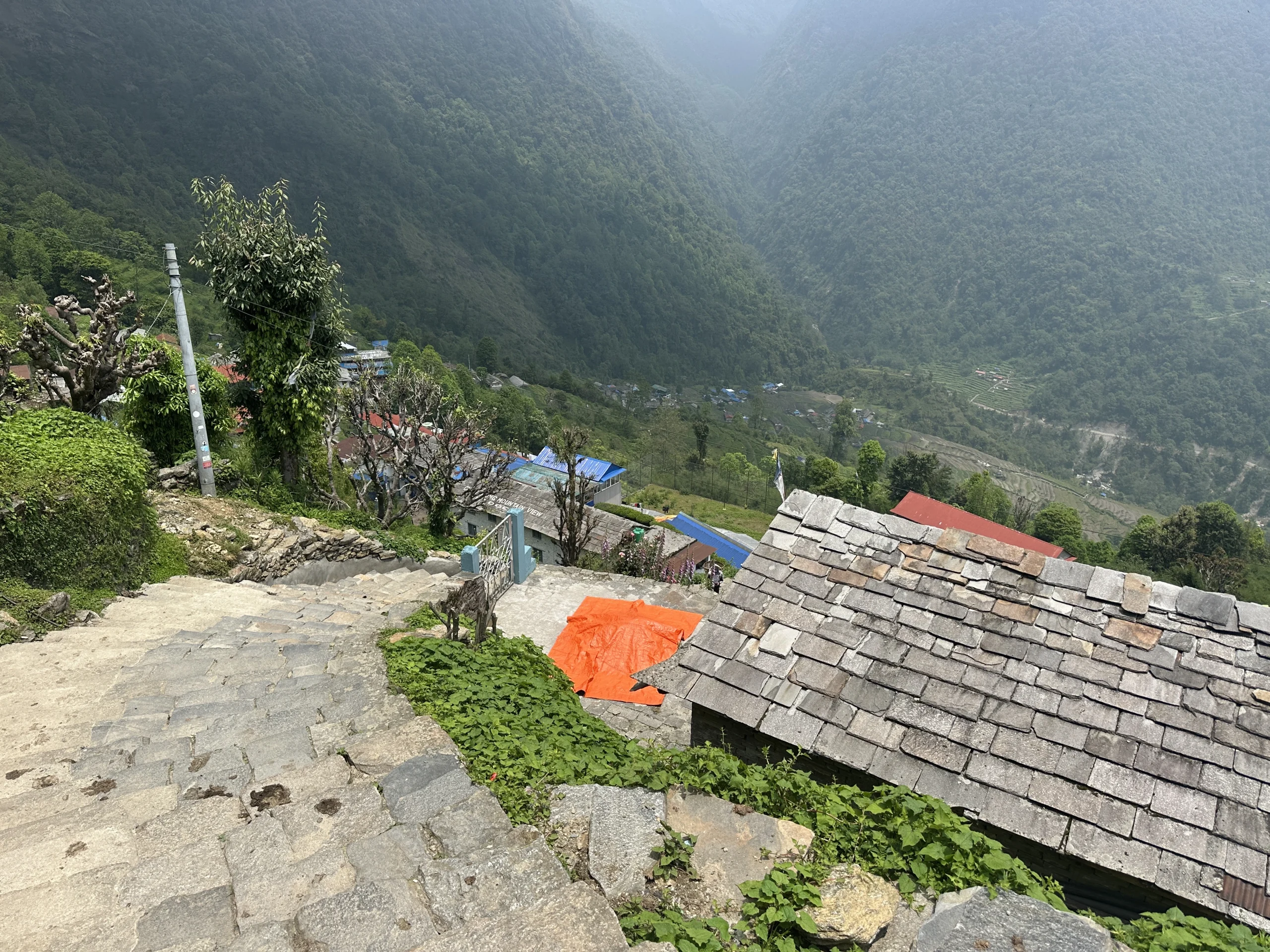
There is no blog article about Chhomrong that doesn’t include the stairs. If you are coming from Jhinu Danda, you have a lengthy, difficult trek up a seemingly never-ending stone stairway to get to the settlement.
It is the major “rite of passage” for every trekker. Your legs will burn, and you will undoubtedly rethink your life choices for 30 minutes. But the trick is that when you reach the top and look back to see the vista, the pain goes away. It is a moment of success that brings all the travelers together in the community. Every step is worth it when you reach the top of the hill and are greeted with a delicious meal and a comfortable bed.
Chomrong is not only a place to rest, but it is also the emotional and logistical hub of the ABC trip. This is the final real settlement before the path turns into forest. It is the community that feeds you, that shelters you, and, if you let it, teaches you some things about living simply on the edge of the world. This guide is for those who wish to do more than simply pass through.
Highlights of Chhomrong Village
- Beautiful Gurung village with traditional mountain culture.
- Mountain views of Annapurna South, Hiunchuli, and Machhapuchhre
- Chhomrong Buddhist stupa
- Lush Hill, terrace, farmland, and animal husbandry
- Suspension bridge over the Modi Khola River that connects Sinuwa
- Comfortable tea house with panoramic mountain views
- Gateway to the Annapurna Base Camp Trek
Quick Fact about Chhomrong village
| Elevation: 2,170 m (7,119 ft) Coordinates: 28°18′ N and 84°13′ E Location: Annapurna Conservation Area, Kaski District, Nepal Region: Annapurna Region Main Ethnic Group: Gurung Community Trail type: One way Stone step: around 2,000 – 2500 Distance from Distance from Pokhara: Approximately 45 northwest Distance from Jhinu Dhanda: Approximately 3 Km Distance from Ghandruk: Approximately 10 Km Distance from Annapurna Base Camp(4,130m): Approximately 27 Km Distance from Machhapuchhre Base Camp(3,700 m): Approximately 20 Km Nearby Places: Sinuwa, Bamboo, Jhinu Danda, Ghandruk Best Time: Spring (March–May) and Autumn (September–November) Accommodation: Teahouses and small shops |
Geography & Getting There: The Road to Chomrong
Annapurna Base Camp Trek starts from Pokhara, the lakeside town, which is 25 minutes by air and 7-8 hours by road from Kathmandu. Jeeps or local buses from Pokhara take trekkers to Nayapul or the trailhead at Siwayi (sometimes spelled Siwai).
The walk to Chomrong usually takes between two and three days, in two ways: on the terraced farmlands of Tikhedhunga or through the rhododendron woods of Ghorepani (if taking the alternative ridge route), or along the trail hugging the river via Jhinu Danda, a popular stop with natural hot springs by the Modi Khola river.
The Infamous Chomrong Stairs
Whichever you choose to go, sooner or later you will come to the Chomrong Khola crossing – a suspension bridge over a milky glacial river and following the famous staircase. From the riverbank to the hamlet is an ascent of 2,500 to 3,000 uneven stone stairs, climbing steeply past terraced farms and tiny communities.
Every trekker who walks these stairs will tell a story that their lungs get burned here. Your thigh starts to complain. Even your trekking poles do not become just equipment; they become your supportive system.
And then you get there. The steps lead out into a broad, stone-paved avenue with tea-houses. There are around 10-15 well-established tea houses here, and even massage and spa facilities. Once you check into the tea house and enjoy a cup of tea/coffee from the terrace with the view of Distally, it is mind-blowing. At that moment, all the pain and exhaustion from the climb disappeared. You are in Chomrong.
Culture & Lifestyle:The Soul of the Gurung Hilands
Chomrong is a village of Gurung, as it is primarily inhabited by the Gurung people, who are famous warriors of the British and Indian Gurkha regiments. The locals have lived here for generations, creating a cultural establishment through agriculture and hospitality for trekkers.
When you walk around the hamlet, you will find signs of this tradition everywhere: colorful prayer flags hanging between houses, old wooden doors, and strong stone houses built to survive the steep mountain landscape.
Tea House Culture
The tea house at Chomrong is more than a place to sleep – it’s the hub of a route for walking. In the evening, the heated dining room is full of trekkers from all over the world sharing stories, resting tired legs, and enjoying hot food after a hard day’s trekking.
Some are talking about the road ahead, others are reading guidebooks or sitting around the fire with mugs of tea. In one corner, family members are living their normal, calm lives — grandparents knit, children study, and owners prepare dinners for visitors. Staying in these tea houses is also a method of supporting the local folks and helping the village maintain its trekking heritage year after year.
Village Architecture & Terraced Fields
Chomrong hamlet has two sections, Upper Chomrong and Lower Chomrong. Both are linked by the same stone steps, which you found so challenging when you initially arrived.
Houses are built of native stone with metal or slate roofs. Some of the walls are painted white, others are kept natural. Many windows have simple patterns carved in them.
Green terraces of fields climb the slope around the town. The people raise millet, buckwheat, potatoes, and seasonal vegetables. In spring, the hills turn yellow from the mustard fields, and the scenery can be seen from far away.
Sustainable Tourism & ACAP
Chomrong is located in the Annapurna Conservation Area, which is maintained by the Annapurna Conservation Area Project (ACAP). For more than two decades, the community has been an example of sustainable high-altitude tourism. Waste management systems take away non-biodegradable trash generated by hikers and tea houses. The lodges run on solar panels and micro-hydroelectric systems. Chomrong is also the last place where meat is commonly available. Beyond Chomrong, up towards Sinuwa and the Annapurna Base Camp region, the sale and consumption of meat is restricted. These are not just rules — they are the reason the Annapurna Sanctuary remains so clean, protected, and naturally preserved.
The Heart of the Trek Chomrong as Gateway & Final Frontier
Every journey has an important junction – a location when things become serious, where day hikers generally turn back, and only dedicated trekkers go on. That area on the Annapurna Base Camp trek is called Chomrong.
The route climbs out of the settlement and into the deeper area of the Annapurna Conservation Area. Villages are less frequent, amenities are relatively low, and the altitude begins to make its presence felt. Now you are no longer simply looking at the mountains. You are strolling straight into them.
The Final Supplies Stop
Experienced hikers see Chomrong as a location to prepare before ascending to higher altitudes. There are small shops in the hamlet selling trekking shoes, souvenirs, snacks, energy drinks, rain ponchos, and warm socks.
There is also a famous bakery in Chomrong which produces fresh bread. Simple, a little sweet, and incredibly delicious after a long hike. Many trekkers purchase bread here and bring it for the following section of the trip as additional energy food.
After Sinuwa, the next settlement, things become more costly, and options are limited. That’s the reason Chomrong is the perfect spot to stock up on supplies before starting the trip.
What to Stock Up On in Chomrong
- Energy bars & chocolate
- Electrolyte sachets
- Homemade bread
- Extra wool socks
- Altitude sickness tablets
- Water purification tablets
- Backup batteries / power banks
Acclimatisation: Why You Must Stay
Many trekkers, energized by the altitude and anxious to reach base camp, get caught in the trap of seeing Chomrong as a lunch break. This is wrong. The settlement is at 2,170 metres, smack in the altitude area where the body starts to take note of the air thinning, not drastically, but noticeably.
But a night in Chomrong is enough for the cardiovascular system to begin to make modifications without our noticing. Producing more red blood cells, recalibrating breathing patterns, and learning to take more oxygen from each breath. Chomrong is normally skipped by hikers who arrive at Deurali or Machhapuchhre Base Camp a couple of days later with headaches and weariness.
Stay at least overnight. Walk through the village in the evening. Slowly drink your tea. Let your body thank you in whispers.
There is a saying, “The mountains do not care how fast you arrive. They care whether you are ready when you do.”
Food Culture Dal Bhat Power: 24-Hour Trekking Fuel
There’s a phrase inscribed on the tradition of Nepali hiking like a mantra on a mani stone: “Dal bhat power, 24 hour.” It is an irony and a deep truth. Dal bhat, a thali dish of steaming rice, lentil soup, vegetable curry, pickled condiments, and typically a side of spinach. This famous Nepali dish fuels the trekkers and himalayan people throughout the year.
In the teahouse of Chomrong, it costs between 400 and 700 rupees (Nepali currency) and includes unlimited refills.
Refill culture is no silly trend. It is hospitality in Nepalese food culture. You finish your rice, Dal, or veg, and the server comes back with a ladle. To a trekker who has walked up and down steps by burning 2,500 calories, they will get a chance to eat until they are really satisfied. It is something like approaching luxury.
In addition to dal bhat, Chomrong’s tea rooms provide garlic soup (thought locally to assist acclimatisation), Tibetan bread, omelettes, and the famed bakery bread described above. It’s worth mentioning the garlic soup: a basic soup, aromatic and comforting, that hikers swear by for unblocking the sinuses and relieving headaches caused by altitude. How it works, whether by chemistry or psychology, doesn’t matter. Drink it.” If you like, get another bowl.
Views & Photography
The Visual Feast: Machhapuchhre & Beyond
Views from the Annapurna Base Camp are stunningly white and incredibly magnificent – a complete circle of some of the highest mountains in the world. But many hikers agree that the most amazing view is really from Chomrong.
Machhapuchhre (Fishtail Mountain) stands magnificently at the end of the valley from the roofs of the higher portions of the hamlet and tea house. This peak is considered holy, and no climbing is permitted.
As the sun rises, the mountain top is the first to be lit, while the valley below remains dark and purple. It makes a gorgeous sight that is there just for a little while before the light spreads over everything. At sunset, the same thing occurs in reverse, and the summit is saturated with yellow against the darker sky.
And that’s a time to get up early, and always have a camera with you because no shot can do it justice.
Best Photography Spots
The major observation point above Upper Chomrong has a good and extensive view of Machhapuchhre. The Chomrong Khola suspension bridge likewise looks quite nice at any time of the day.
The stone steps are particularly attractive in spring, when rhododendron flowers blossom around them.
It is frequently foggy in the early morning down in the valley beneath. One simple but wonderful experience is to see this from a tea house terrace with a cup of tea in your hand.
Day by Day: The Chomrong Experience
Day 1: Arrival & Exploration
Try to arrive in Chomrong in the mid-afternoon, so you have enough time to choose a good tea house. Don’t take the first place offered at the bottom of the stairs — walk through the village first and look around before deciding.
Small, family-run tea houses are usually better than large commercial ones. The welcome feels warmer, and the food, especially dal bhat, is often more delicious.
After settling in, take a walk through the village’s stone paths as the afternoon light changes. Talk to the local owners and ask about the trail ahead. They usually know a lot about weather conditions, snow at Machhapuchhre Base Camp, and which parts of the route are difficult. These simple conversations can be very helpful for your journey.
Day 2: Acclimatisation Walk
Instead of heading straight on to Sinuwa, spend a full day exploring the nature around Chomrong. Walk to the edge of the settlement and stare down into the gorge of the Chomrong Khola. Walk the descending fields. Go to the little monastery above Upper Chomrong. These easy hikes help you to prepare for the upcoming trails to MBC and ABC.
Day 3: The Departure Toward Sinuwa
To get out of Chomrong, you have an exhausting journey of steps down to the river, you cross it, and climb straight up again into Sinuwa via bamboo and rhododendron trees.
This section of the path is particularly scenic. The forest surrounds you, little waterfalls arise on the route, and the sound of the settlement fades slowly into birds chirping.
The ascent is tough, but not as lengthy as the Chomrong steps. Upon arriving at Sinuwa, you really feel as if you are within the mountains. The trek into the sanctuary starts from here.
Practical Gear
The Chomrong-Tested
Kit List
The steps of Chomrong are like a gear test.” In only a few steps, you’ll know whether your boots fit nicely, your rucksack is too heavy, and if trekking poles would have been a smart idea.
Here’s the essential gear you truly need for this sort of trail:
- Trekking poles (non-negotiable)
- Broken-in trekking boots
- Layered clothing system
- Down sleeping bag (-10°C rated)
- Rain cover + pack liner
- Headtorch + spare batteries
- Water purification (tablets/filter)
- Sun protection (high SPF + lip balm)
- Basic first aid kit
- Altitude sickness medication
- Power bank (large capacity)
- Nepali rupees (cash only)
A note on trekking poles: On the Chomrong stairs specifically, poles take an estimated 30% of the load off the knees on descent. Buy from Pokhara and do not attempt the trek without them if it’s your first time trekking.
Practical Guide: Everything You Need to know Before you Go
Where to Stay
Chomrong has a dozen teahouses, from extremely basic to quite luxurious by mountain standards. A hot shower (solar-heated, and thankfully accessible in most lodgings) costs an additional 400 to 500 rupees. Room costs are inexpensive – usually 1000 to 1500 rupees – since the tea houses make their margins on meals. There is a community agreement on the trail to eat at your lodge, and it keeps the town economy functioning.
Connectivity
Wifi and mobile networks exist in Chomrong. Speed is good, but in the peak season, due to the huge number of trekkers, the Wifi speed might be slow. Above the Chomrong, the mobile network starts to get weak and patchy. There is no mobile network in MBC and ABC, but wifi works fine in the teahouses.
Best Season to Visit
- Spring (March – May): Rhododendrons in full bloom, and the hillsides are crimson and pink. a little warmer. Mornings are often bright, although clouds might develop in the afternoons. The most stunning season for photographers, visually.
- Autumn (Sep – Nov): The monsoon is over, and bright skies are a guarantee, delivering the sharpest, most spectacular mountain vistas. But the temperatures fall dramatically after October. The busiest period on the route – reserve tea houses in advance if you have the option.
Budgeting
Accommodation, three meals, snacks, and hot showers in Chomrong will cost you between USD 20 and 30 a day. Above Chomrong costs increase by 20-40% for every day’s trek. Carry enough cash from Pokhara – no ATMs on the trekking route.
Required Permit
All the trekkers heading to Chomrong village must obtain the Annapurna Conservation Area permit(ACAP). It will cost NPR 3,000 for foreign and NPR 100 for Nepalese. You can obtain the permit from Pokhara/Kathmandu or at the checkpoint of Birethanti.
Final Thoughts
When you are heading for the ABC trek, we suggest you not to rush because trekking is about exploring, not a marathon to finish. Chomrong is more than a village; it has a natural power to heal your mind. Surrounded by Himalayan views, monasteries, and local life, it is a place to slow down, relax, and truly experience the mountains. When you are here, respect local customs, support community-run lodges, and travel at the pace the mountains intend.
Peaceful Nepal has strong connections with the local teahouse in Chomrong. If you want to visit this wonderful village and experience the beauty, then call us now and make your dream come true. Thanks for reading!!!
Frequently Asked Questions( FAQ)
1. Where is Chomrong located?
Chomrong is a small, beautiful village located in the Annapurna region inside the Annapurna Conservation Area of Nepal. It is an important stop for travellers heading for the Annapurna Base Camp, located at an altitude of 2,170 meters (7,119 feet)
2. Why is Chomrong important for the ABC trek?
It is the last village that has good facilities like shops, tea houses, and bakeries before entering a higher altitude. Stopping here for a night helps to recover and prepare your body for the more challenging sections ahead.
3. What facilities are available in Chomrong?
Chomrong has many tea houses, lodges, small shops, bakeries, and limited trekking supplies. Some places also offer Wi-Fi, hot showers, and simple spa services.
4. How difficult is the trail to Chomrong?
Actually, the trail to Chomrong is quite challenging due to continuous steep stone stairs and ups and downs. It demands good fitness from trekkers, especially leg strength, but the walk is manageable with resting and proper pacing.
5. What is the best view from Chomrong?
From Chomrong, you can enjoy an unforgettable view of Machhapuchhre (Fishtail Mountain), Annapurna South, Hiunchuli, and a beautiful, lush hill. Also, the sunrise and sunset views from here are stunning.
Posted on