

Introduction
The air thins with every step. Somewhere behind you, the last cluster of stone houses has already disappeared into the folds of the hillside. Only your breathing remains. You can also hear the dry snap of prayer flags above. Then, without warning, the trail rounds a ridge. A small group of whitewashed buildings appears. They cling to the hillside as if they grew from it.
Behind them, the whole sky is filled by Mt. Manaslu(8,163 meters), one of the eight highest mountains in the world. It is a massive wall of ice and rock. Locals call it Kutang, the “Mountain of the Spirit.” At this moment, Pungen Gompa and the mountain feel deeply connected.
Pungen Gompa (also written Pungyen Gompa or Pung Gyen Gompa) is a small and historic Buddhist site in Nepal’s Manaslu region. It sits just off the main Manaslu Circuit trekking route within the restricted area. It is located northeast of Samagaon at an altitude of approximately 4,000 meters (13,123 feet). Because of this, very few people visit it.
Those who reach here often describe it as peaceful, spiritual, scenic, and different from anywhere else on the trail. The main Manaslu Circuit trail is a busy trekking route with the flow of porters, mules, and visitors in teahouses stopping for Dalbhat and resting.
Pungen Gompa feels different. It asks you to step away from all of that. When you reach this monastery, you will be surrounded only by wind, prayer wheels, and the beautiful Himalayas. It is quiet and more peaceful. Not every trekker comes here. But those who do often say it is one of the most meaningful stops on the journey.
The Spiritual Significance of Pungen Gompa Monastery)
History
Pungen Gompa’s story is closely tied to the identity of the Nubri people. These are Tibetan-descended communities who have lived in the shadow of Mt. Manaslu for centuries.
Local tradition says the monastery was built to honor Lord Pungyen. He is a protector deity connected to Mount Manaslu itself. Even the name “Pungen Gompa” reflects this deep respect. It comes from Tibetan words linked with adornment and offerings. It shows the mountain is not just seen, but honored.
For generations, the Nubri and nearby Tsum Valley communities have treated this entire landscape as sacred. The land around Manaslu is believed to hold strong spiritual energy. Because of this, it is seen as a place for meditation and learning.
Both the Nyingma and Sakya schools of Tibetan Buddhism recognize this region as important for spiritual practice. Pungen Gompa grew from this belief and tradition.
But the monastery has not had an easy history. It was badly damaged in the 1934 earthquake. The local community rebuilt it slowly over time. Then it was hit again by the 2015 earthquake.
Each time, it was restored. Local families and supporters helped rebuild it. This shows how important the Gompa is to the people who live here. It is not only a religious site. It is also a symbol of resilience, faith, and connection to the sacred landscape.
The “Hidden” Aspect
Long before it appeared on the Manaslu trekking itinerary, Pungen Gompa had a different role. It served as a place of refuge.
Monks and spiritual practitioners came here to stay away from worldly life. They climbed into these hills on purpose. The location was hard to reach, and that was the meaning of it. Isolation was the goal.
A monastery placed high on a ridge, far above the nearest village, is not by chance. There is no road, no shortcut. People came here to hear their own thoughts more clearly. That original purpose still shapes the feeling of this place today.
Unlike many monasteries now linked with busy trekking routes, Pungen Gompa has still kept its remoteness. It has not turned into a tourist stop. There is no gift shop. No crowd control.
No line for photos.
Instead, you find what those early monks once sought. Silence, thin cool Himalayan breeze, and a wide, open view of Mt. Manaslu. For many, it still feels like a sacred space above the noise of the world.
Cultural Etiquette
Because Pungen Gompa is still an active place of worship, visiting comes with a few simple but important expectations for travellers.
- Walk clockwise around stupas, chortens, and prayer wheels. This is the traditional direction in Tibetan Buddhism. Walking the opposite way is seen as disrespectful.
- Dress modestly. A good rule is to cover your shoulders and knees. This is especially important if you enter a prayer hall.
- Keep your voice low. This is not a place for loud talk or music. If monks are praying or performing rituals, observe quietly from a distance. Do not interrupt.
- Ask before taking photos of monks, ritual objects, or inside shrine rooms. A little respect goes a long way in a place that sees few visitors.
- Leave everything as it is. Prayer flags, stones, and offerings all have meaning. They are not souvenirs and should not be moved.
None of these rules is difficult, but they matter deeply. We should follow the eco-friendly and sustainable tourism practices even if no one is seeing us. We should respect this place, and it should remain a place of real practice, not just a scenic stop for photos.
The Trek: Getting There
Most adventurers on the Manaslu Circuit pass the turnoff for Pungen Gompa without even noticing it. The main reason is that it is a side trip, not a part of the main trekking route. The side to Pungen Gompa starts from Samagaon village. The climb does not ease until you reach the monastery gates.
The scenery and landscape change quickly as you start to hike from Samagaon towards Pungen Gompa. First, you will walk through the pine and fir forest. As the trail switches back up the hillside, the trees slowly thin out. They give way to scrub vegetation and then open alpine land. You see rock, low grass, and wider views in every direction.
As you climb higher, Mt. Manaslu begins to dominate the horizon. Its glaciers and ridgelines become clearer with every step. Also, the distant view of the monastery starts to appear sharp.
By the time you come close to the Gompa, the snow-capped peak no longer feels far away. It feels close. You can almost study its seracs and snowfields in detail.
- Starting point: Samagaon village( approximately 3,530 meters)
- Samagaon to Pungen Gompa distance: 14 to 15 kilometers (about 8.5 to 9.5 miles)
- Samagaon to Pungen Gompa hike duration: ( 3- 4 hours ascending, 2-3 hours descending)
- Altitude gain: 470 meters
- Hike difficulty: moderate to strenuous due to thin air, remote location, and steep climb.
How difficult is it to reach the Pungen Gompa?
The hike to Pungen Gompa is not for everyone. Honestly, no – and that needs to be said clearly. This is not an easy walk added to an already long trekking day. The climb from the main trail is steep and sustained. It adds real elevation gain on top of the distance you have already covered that day. Depending on your pace and fitness, the round-trip side excursion can take several extra hours.
That said, “difficult” does not mean it should be skipped.
Most high-altitude hikes on the Manaslu Circuit are already acclimatizing well by this stage. The climb is demanding, but it does not require technical skills. It needs stamina, good trekking boots, and slow movement in thin air.
If you are feeling strong and want a meaningful challenge, this side excursion is worth it. It breaks the rhythm of the main trail and adds a rewarding experience to the journey.
The Reward:
There is a particular point on the trail, usually as you crest one final rise, when everything opens up. The monastery buildings come into view, with Mt. Manaslu’s South Glacier spilling down behind them. It is the kind of moment that often stops backpackers mid-stride.
The Gompa’s low stone and whitewashed structures look small against that huge wall of ice and rock. The scale of the Himalayan peaks suddenly feels very human from here. It is a perspective you rarely get anywhere else on the circuit.
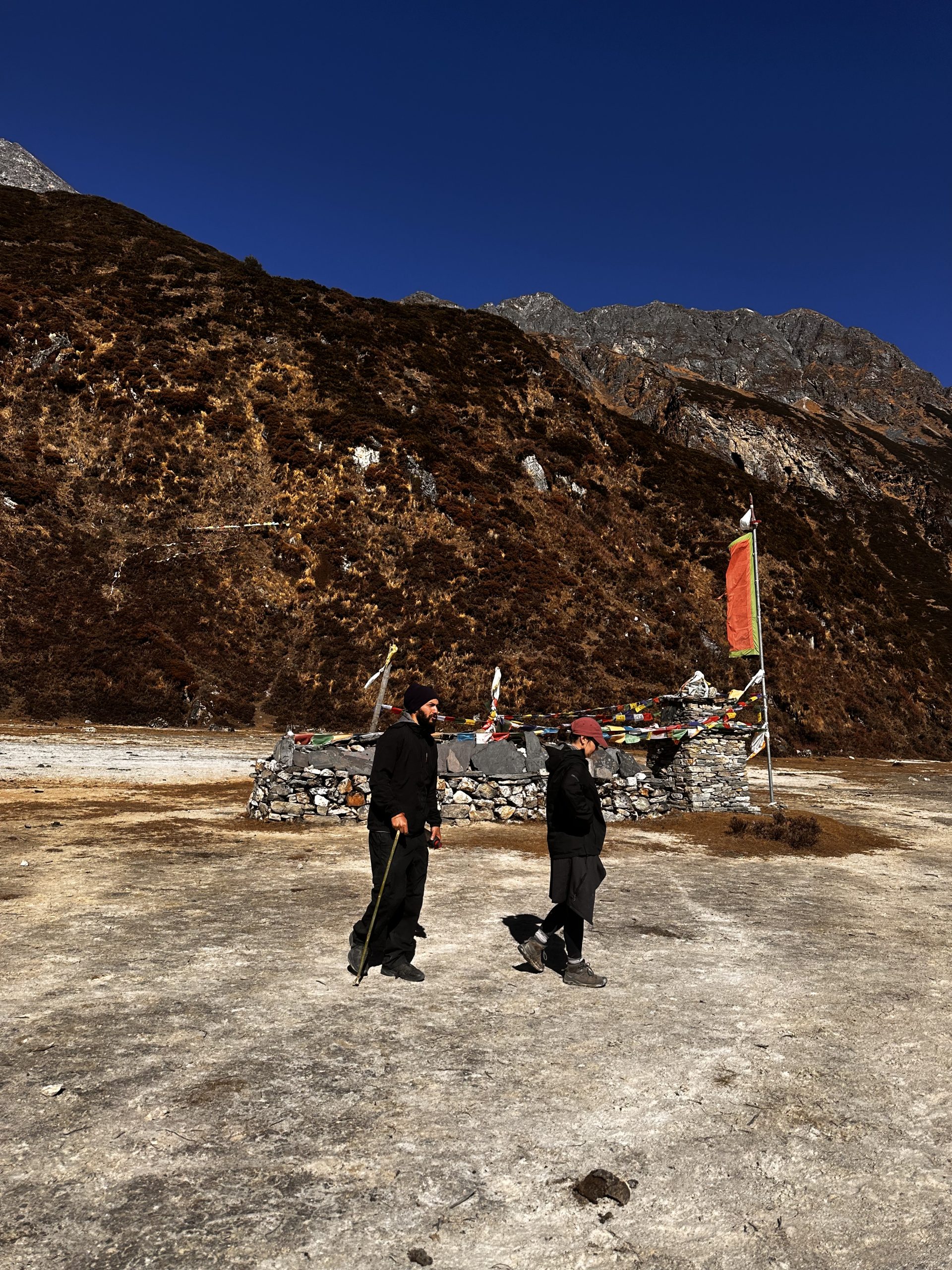
Prayer flags are stretched between the buildings. They snap hard in the wind coming off the glacier. For a moment, there is nothing to do except stand still and take it all in.
Why It’s a Must-Visit Place?
Some of the Best Manaslu Views on the Entire Circuit:
Ask travellers who make the detour, and many will say the same thing. The view of Mt. Manaslu from Pungen Gompa can match, or even beat, other famous viewpoints on the route.
Some of those spots get more attention in trekking guides. They also see far more foot traffic. But Pungen Gompa sees only a few visitors.
Because the Gompa sits slightly above and to the side of the main valley, it offers a unique angle of the mountain. You get a clear view of the south face and its glacier system. This is a perspective you cannot see from the standard trail.
There are no villages in front. No lodges blocking the view. No groups of tourists standing between you and the alpine scenery. It is just open space, moving wind, and a huge wall of ice.
A Photographer’s Dream:
If photography is part of why you are trekking, this spot deserves real attention.
The foreground here is strong. You have weathered stone buildings, fluttering prayer flags, and chortens. In the background rises the massive glaciated face of Mt. Manaslu.
This combination creates a rare and powerful composition.
For the best light, go early in the morning. The sun stays low and hits the ridgelines at an angle. It brings out texture, shadows, and depth in the ice.
Later in the day, the light becomes flatter. The contrast fades, and the surrounding peaks can lose some detail.
If your schedule allows, morning is clearly the better time for photos.
A Smart Step for Acclimatization
There is also a very practical reason to take this side hike beyond views and atmosphere: altitude.
The climb up to Pungen Gompa gains a significant amount of elevation over a few hours. Visitors do not stay at the Gompa. They climb up, explore, and then descend back down the same day.
This creates a natural “climb high, sleep low” pattern.
It is one of the most effective ways to help your body adjust to altitude. You gain height during the day, then return to a lower sleeping point.
This approach helps as you continue toward higher places on the circuit. It becomes useful preparation for the challenging mountain pass, Larkya La Pass, which rises above 5,106 meters.
In this sense, the hike to Pungen Monastery is not only scenic. It is also practical for acclimatization.
A Genuine Moment of Zen
Perhaps the most understated reason to visit is the silence itself. Teahouses along the main Manaslu Circuit have their own charm. But they are social spaces. You hear conversations, cooking, and the steady movement of a busy trekking route.
Pungen Gompa is the opposite. It is a place built for quiet reflection. Everything about it encourages stillness and contemplation.
Standing in the courtyard, you notice the slow turn of prayer wheels in the wind. Inside the monastery, you will explore ancient Buddhist relics, a small prayer hall, and monk dormitories. Above you, Mt. Manaslu stands dramatically. It is hard not to slow down here, even mentally.
Many trekkers say this is one of the few moments on the entire circuit where they truly stop. Not just physically, but emotionally. They sit with the landscape instead of moving through it.
Best Time to Visit
Morning is clearly the best time to visit Pungen Gompa. It is not only for photography but also for visibility.
In the Manaslu region, clouds often build up throughout the day. This is common in both post-monsoon and pre-monsoon seasons. By afternoon, the upper peaks of Mt. Manaslu are often hidden in haze or clouds.
Starting early gives you a better chance of a clear view. It is best to leave your teahouse early in the morning and return at midday if possible.
What to Pack
There are no tea houses or shops at Pungen Gompa. Everything must be carried with you.
- Bring more water than you think you need. There is no refill point on the route.
- Carry snacks or a light lunch. You will not find food at the monastery.
- Pack an extra warm layer. Even if the lower trail feels warm, it gets colder with altitude. Wind from the glacier can make the courtyard feel much colder.
- A buff or light head cover is useful. It helps with sun protection and is also good for modesty if entering prayer halls.
Safety and Altitude Awareness
The climb to Pungen Gompa involves real elevation gain in a short time. It comes at a stage of the trek where altitude already matters.
Pay attention to your body. Symptoms like headache, dizziness, nausea, or unusual fatigue should not be ignored.
If these signs appear, it is better to turn back and descend. The view will still be there another day. Don’t go for a hike without taking a trekking Guide with you.
Permits and Donations
The Manaslu region is a restricted trekking area. A restricted-area permit is required, along with conservation area permits. These must be arranged in advance through a registered trekking agency. Along with the permit, it is mandatory to have travel insurance when you are trekking in a restricted region of Nepal.
There is usually no fixed entry fee at Pungen Gompa. However, a small donation is appreciated. It helps support the monastery’s upkeep.
The Gompa has faced earthquake damage more than once. Community support, including help from visitors, plays an important role in its restoration and maintenance.
Final say
When tourists are heading out for the Manaslu Circuit trek, they often focus on the Manaslu trek distance, villages, and especially the Larkye La pass. Trekking is not only about walking and reaching the destination. People remember unique places like Pungen Gompa, prayer flags fluttering in the sky, and Mt. Manaslu.
The main trail will always be there, with its teahouse and other trekkers, but Pungen Gompa is different. It requires little effort from the travellers, but the peaceful location, soul-enriching environment, and scenic landscape views make it worth visiting.
If you are planning to do the Manaslu Circuit trek and hike to this beautiful monastery in Nepal, then Contact Peaceful Nepal. We run the Manaslu Circuit trek package and handle everything that you need to make your journey wonderful.
Posted on