
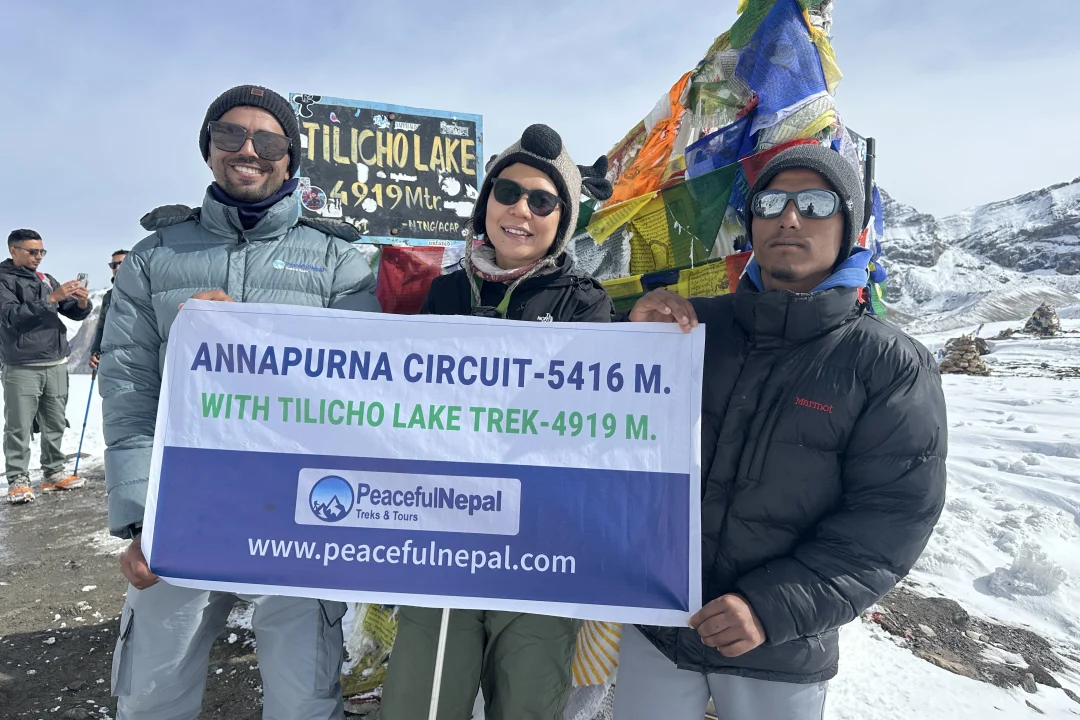
If you are a trekker and have heard about Tilicho, you definitely dream of trekking to Tilicho. A perfect trek who loves mountains, nature, and the Himalayas culture, this trek will take you to the world’s highest glacier lake.
Tilicho Lake, a glacier-made, world’s highest lake, is a dream destination for trekkers and a spiritual destination located in the Annapurna region of the Nepal Himalayas. Located at 4,919 m/16,138 ft above sea level in the Manang District of Nepal, it lies at the base of Tilicho Peak and also between Annapurna and Nilgiri Mountain. Tilicho Lake is 160 kilometres (Km) away from Kathmandu and 55 Km aerial distance from Pokhara. The lake is mainly supplied by water from melted snow and glaciers flowing down from the surrounding himalayan peaks, particularly Tilicho peak. Although water flows into the lake from surrounding glaciers and streams, there is no visible river flowing out of it. Experts believe the water escapes through underground channels or by evaporation. The water is a stunning turquoise-blue colour, which is a result of glacial rock flour: fine, powdery silt created by ancient glaciers grinding against rocks . The Tilicho lake trek as a standalone adventure is a shorter himalayan trekking experience designed for travellers who wish to explore the breathtaking Tilicho lake (4,919 m) without undertaking the full Annapurna circuit trek.
The Tilicho trek provides high-altitude adventure, himalayan villages, mountain views and a rich cultural experience of the Gurung, Thakali, and Manangi ethnic groups. It has cultural and religious value, solely for Hindus and Buddhists.
The Tilicho lake trek requires good preparation because of its high altitude, and the fact that trails are difficult, rocky, and challenging. It is one of Nepal’s most rewarding adventures, featuring breathtaking Himalayan scenery, dramatic landscapes, and the stunning crystal-clear waters of the Tilicho. Visitors can witness the amazing view of Tilicho peak (7,134 meters) in the northwest direction, Nilgiri in the north, and the Annapurna range in the south and southwest, including Annapurna I, Annapurna II, Annapurna III, and Gangapurna in the east. Also, we can experience serene hiking compared to other parts of the Annapurna region. Despite that, this trek is quieter and less crowded than other treks like the Everest Base Camp trek; you will experience nature and the Himalayas in a peaceful environment.
This trek is moderate to challenging because of rocky paths and narrow trails with steep drops on the side, but every year, thousands of Nepali and international trekkers take on this challenge, just to experience the beauty of Tilicho and the journey to get to the destination. It’s more challenging not because of a huge amount of walking or difficult trails but because of high altitude; trekkers might get altitude sickness quite frequently, and because of the lower oxygen level, people feel dizziness, headaches, and vomiting. People who do long hiking, regular exercise, and are physically fit might not get troubled with this issue, but every trekker should take proper precautions before beginning the journey.
Tilicho Lake is normally an 8-day adventure trek in Nepal’s Annapurna region. This 8-day itinerary has been carefully designed to provide trekkers with a safe, comfortable, and memorable journey from Kathmandu to Tilicho Lake and back.
The ideal season to visit Tilicho Lake is during spring (March to May) and autumn (September to November). Autumn is considered the best overall season because the weather is stable and the skies are cloudless and clear after the monsoon rains. And also, in spring, you will witness the beauty of rhododendron trees bursting into vivid red, pink, and white blooms & snow-capped peaks, but the lake might be frozen during Maytime.
During winter, trekking is possible to Tilicho, but due to a drop in temperature below -20 degrees Celsius, a very cold temperature, you need to be extra careful; during these times, trails will be
empty, and you will observe top alpine adventures. But in the monsoon season, due to dangerous road and trail conditions due to monsoon rain, landslides will occur, so trekking during this time will be risky. Trekking during the monsoon season will not be the right decision.
Tilicho Lake is a moderate-to-challenging trek due to its high elevation, sloping terrain, and steep trails. Trekkers pass through rocky and narrow paths, unstable slopes, and gradual altitude gain. Altitude gain is one of the obstacles of the Tilicho trek; you might experience altitude sickness. Due to the narrow path and landslide-prone area, the area above Shree Kharka is considered more challenging, but every year, thousands of Nepali and international trekkers do it.
You need to be physically and mentally prepared for this trek. Activities like jogging, swimming, and hiking help strengthen the body, which helps during the 6-8 hours of trekking up and down the hills and in the high elevation of the Tilicho trek. If you can walk for several hours uphill and have completed a few similar treks, you can do this trek easily, but you always need to be aware of the altitude sickness symptoms.
While trekking, respect the local culture and traditions of the places. Wear decent and comfortable dress when visiting villages and monasteries, and remove your shoes before entering religious places and local houses. Walk in a clockwise direction on stupas, temples and mani walls, and always ask for permission before taking a photograph of a religious place and local people. Respect local customs, be polite and treat the local people with kindness throughout your journey.
The Tilicho Lake trek is perfect for those who want to experience the beauty of the Himalayas and the rich culture of Nepal in one journey. The trek takes you to Tilicho Lake (4,919 m), one of the world’s highest lakes, surrounded by spectacular mountain views.
Along the trail, you’ll pass through remote villages, experience local traditions, taste authentic Himalayan food, and enjoy the warm hospitality of the local people. Compared to many popular trekking routes, the Tilicho Lake Trek is less crowded, offering a peaceful environment and a more authentic trekking experience.
Mountain | Altitude |
Annapurna II | 7,937 m |
Annapurna III | 7,555 m |
Khangsar Kang (Roc Noir) | 7,485 m |
Gangapurna | 7,455 m |
Tilicho Peak | 7,134 m |
Nilgiri North | 7,061 m |
After visiting Tilicho Lake, most trekkers return to Tilicho Base Camp and continue the classic Annapurna Circuit route. The journey follows these stages:
Another alternative route of Tilicho Lake trek is the Mesokanto La Pass route. The Mesokanto La Pass is a challenging alternative to the standard return trail from Tilicho Lake. Instead of backtracking, this route crosses the 5,330m Mesokanto La Pass and descends towards Jomsom.
This route is recommended only for experienced trekkers. The trail is steeper, less marked, and more remote than the classic route, requiring good physical fitness, proper equipment, and an
experienced guide. If you’re looking for a quieter and more adventurous trekking experience, the Mesokanto La Pass offers stunning mountain scenery and fewer crowds.
| Day | Route | Starting Altitude | Ending Altitude | Approx. Distance | Walking/Travel Time | Difficulty |
| 1 | Kathmandu → Besisahar → Chame (Drive) | 1,400 m | 2,670 m | 240 km | 10–12 hours | Easy |
| 2 | Chame → Pisang | 2,670 m | 3,250 m | 13–15 km | 5–6 hours | Moderate |
| 3 | Pisang → Manang | 3,250 m | 3,540 m | 16–18 km | 6–7 hours | Moderate |
| 4 | Manang (Acclimatization Day) | 3,540 m | 3,540 m | Optional hike | 3–5 hours | Easy |
| 5 | Manang → Tilicho Base Camp | 3,540 m | 4,150 m | 14–16 km | 7–8 hours | Challenging |
| 6 | Tilicho Base Camp → Tilicho Lake → Shree Kharka | 4,150 m | 4,080 m | 15–17 km | 7–9 hours | Very Challenging |
| 7 | Shree Kharka → Manang (Walk) → Besisahar (Jeep) | 4,080 m | 760 m | ~6 km walk + jeep drive | 2 hours walk + 6–8 hours’ drive | Moderate |
| 8 | Besisahar → Kathmandu (Drive) | 760 m | 1,400 m | ~175 km | 8–9 hours | Easy |
On the first day of the trek, The journey begins from Kathmandu early in the morning by private vehicle or tourist bus. You will go through the Prithvi Highway, and while heading northwest, the route offers scenic views of the Marsyangdi River. You will reach Besisahar, the headquarter of Lamjung; it will take around 5-7 hrs. From Besisahar, the journey continues to Chame (2,670 m) by jeep. During the journey, travellers will pass various villages such as Ngadi, Bahundanda, Jagat,
Dharapani, Bagarchhap, and Danaque before arriving at Chame. It will take around 4-5 hours to reach Chame and spend the first night, in comfortable and luxurious hotels.
Your leg journey starts from Chame. The official trek begins on day 2; after having breakfast, you will head towards Pisang (3250 m), following the Marsyangdi River upstream by crossing pine forest, small villages, and bridges, witnessing the stunning mountain peaks, such as Annapurna II. After 5-6 hours of walking uphill, the route reaches Pisang, which is divided into Upper and Lower Pisang at an elevation of 3250m. Spending the second night here provides an opportunity to enjoy the extraordinary scene and atmosphere.
On the 3rd day, the trek continues from Pisang to Manang, the largest and most beautiful mountain village, located at around 3,540 meters in the Annapurna region. Manang valley has a unique character of flat-roof stone houses, prayer flags, mani walls, stupa. The village has a variety of guesthouses, tea shops, bakeries, and even a small health facility. It will take around 5-6 hours to reach this destination. Here, you will get to see Manang valley and the Tilicho peak. Explore the Manang and give your body plenty of rest as it is necessary for your body to get familiar with the conditions. During your stay in Manang, don't miss the local bakeries, where you can enjoy freshly coffee, delicious cakes, and a relaxing atmosphere.
On the 3rd and 4th days, you will take rest to acclimatize your body. As trekkers ascend towards higher elevations, the body needs time to adapt. An extra day in Manang allows the body to adapt to the higher altitude and reduces the risk of mountain sickness. During your stay, you can hike to the Gangapurna glacier and Khangsar village. Also, Braga Monastery is located within a short walk from Valley, which is the oldest and most admired monastery in the Manang region. These places are nearest to Manang, so you can return to your place of stay; also, it helps to adapt the attitude. To follow the golden rule of higher elevation trekking, “climb high, sleep low," it will be best to do a short hike for a day.
On this day, in the early morning, you begin your trek and head towards Tilicho base camp, also known as Shree Kharka or Tilicho Hotel, at an elevation of approximately 4,150 meters. After leaving Manang, the lush forests gradually disappear, giving way to a dry, rocky alpine landscape. You will pass through the small village of Kangsar after crossing the river on a suspension bridge, where you can stop for rest or tea/coffee. The trail above Shree Kharka is one of the narrowest sections of the trek, with a few landslide-prone areas that require extra caution. This day trek is a little bit more challenging than the previous day trek. The trek offers a wonderful view of the Gungang and Chilo mountains. This day's last station is Tilicho Base Camp, also known as Shree Kharka, where comfortable teahouse accommodation is available. Surrounded by yak pastures and rugged alpine scenery, the base camp offers a peaceful place to relax and prepare for the early morning hike to Tilicho Lake. Spend the night here, resting and enjoying the mountain atmosphere.
The most rewarding and memorable day of the entire trek. The hike will begin from Tilicho Base Camp towards Tilicho Lake while ascending the challenging, difficult, and steep mountainside path. Even though the trail is challenging, trekkers will enjoy stunning mountain views. You need to start your trek very early in the morning to see clear views of the mountains and to avoid the wind, which will start at midday. After several hours of trekking, the trail reaches Tilicho Lake (4919 m), where you can see the turquoise, crystal-clear lake surrounded by numerous mountains. A long and challenging journey to reach tilicho lake, a peaceful and quiet atmosphere, far away from the noise and crowds, gives trekkers an inner peace that makes them stay a little longer.
Seeing the view of the lake surrounded by mountain peaks and taking photographs, you reflect on the remarkable journey you have had to return after spending 30-40 minutes there; you need to get back to Shree Kharka. The sunlight shining on the lake, the snow-capped mountains around it, the peaceful surroundings, and the long journey to reach Tilicho Lake make it hard for trekkers to leave. Because of the cold temperature, strong wind and high elevation, staying for several hours is not generally recommended.
On the 7th day, your return journey will start. After 2 hours of downhill trekking from Shree Kharka, you will reach Manang village and board the jeep for Besisahar. Depending on road conditions and weather, it will take approximately 4-5 hrs. You will spend your final mountain night of the Tilicho trek in Besisahar.
After spending the night in Besisahar, begin the drive back to Kathmandu by local bus, which takes around 8-9 hrs. This comfortable bus journey will pass through Prithvi Highway, passing through Dumre, Mugling, Thakre, and Naubise before entering Kathmandu. The road follows the Marsyangdi and Trisuli rivers, offering views of the mid-hills.
Upon arrival in Kathmandu, the Tilicho Lake Trek comes to an end, leaving unforgettable memories and himalayan adventure.
During the Tilicho Lake trek, local guesthouses, called teahouses, are available along the route. From Besisahar to Tilicho Base Camp, family-run teahouses are found in nearly every village, offering warm hospitality, fresh, home-cooked meals, and comfortable, clean rooms and facilities. Staying in these teahouses provides an opportunity to experience the local culture of the communities living in the Himalayas. Accommodation during the whole trek is budget-friendly. Most teahouses offer twin-bed rooms with mattresses, pillows, blankets, and shared bathrooms.
At lower elevations, the facilities will be more standard; tea houses offer facilities like hot showers, wi-fi, a charging port, and laundry services, but these services might be an additional cost. As the trek reaches higher elevations, the accommodation will be limited, and you will only get basic facilities. Charging electronic devices becomes more expensive at higher elevations because electricity is limited and oftern generated by solar power.
A variety of foods like momos, noodles, thukpa, potatoes, fried rice, eggs, soups, daal vaat, etc., are available during the entire trek, but at higher altitudes the variety may be limited. Breakfast options commonly include bread, toast, tea, and coffee. You will get the most popular Nepali traditional meal, Daal Bhat Tarkari, which includes a seasonal curry, rice, and lentil soup. This dish is full of carbohydrates and protein, which provides plenty of energy for trekking and often comes with free refills, so it will also be a good choice to have during trekking. Besides these, you can enjoy a range of meals.
As you reach higher altitudes, food prices increase because supplies are transported by porters and yaks. During the peak trekking season, hotels can fill up quickly, so reserve the rooms before you reach so that you don’t get into trouble, mostly in popular stops like Tilicho Base Camp. During the season, due to limited teahouses and rooms, trekkers have to spend nights in the dining area, where mattresses and blankets are usually provided.
Trekkers are required to obtain two essential permits. Trekking without permits is considered illegal, and you will be charged a fine, if found doing so. Annapurna Conservation Area Permit (ACAP) and Trekkers Information Management System (TIMS) card are mandatory to enter the Annapurna Conservation Area, where Tilicho Lake is located. These two permits are required to monitor trekkers, respond in case of emergencies and ensure compliance with conservation rules.
A passport copy, a passport-sized photo, an application form for ACAP/TIMS, itinerary details and payment will be required to get a permit. The most convenient place to get a permit is at the Nepal Tourism Board office in Kathmandu or Pokhara, Nepal. Trekking permits are not available once you’re on the trail, so obtain them before starting the trek.
Internet service has been available to serve the needs and for the convenience of tourists for the past few years, mostly to reduce incidents of people missing or falling ill during Tilicho Lake trekking and also to update the family members of the trekkers about their location and progress. In case someone suffers from illness or emergencies or if someone goes missing, internet access also helps facilitate timely communication and assistance.
Throughout the trek, network connectivity is available; the signal might be unavailable or weak on remote sections, especially at Tilicho Lake and Tilicho Base Camp, as signal strength decreases at higher elevations and while crossing some villages. Mobile network connection is good in lower villages. Mobile network coverage becomes less reliable after Manang, so it’s best to inform family
or friends before heading toward Tilicho Base Camp. Many teahouses in lower villages have a wi-fi connection for an additional cost. NTC SIM will get coverage in most of the places for phone calls but not for the internet. Internet data around the trekking route is very slow.
Tilicho Lake does not require extra skills like climbing; it’s quietly physically and mentally demanding due to long walking hours at high altitude and on narrow paths and quickly changing weather conditions. You need to be prepared 3-4 weeks before the trek by improving your leg strength.
Before the trek, it will be more effective if you do physical exercises, like squats, planks, or other exercises that help build stability and balance and leg strength. Cardiovascular activities such as jogging, hiking, and skipping before the trek help you handle the long walking hours and high-altitude conditions on the trek. Also, do a health checkup before the trek to know any medical conditions at an early stage that prevent serious illness during the trek. And always do medical insurance and travel insurance that covers high-altitude trekking because health facilities are limited in the upper regions of the Annapurna Area.
Choose and check comfortable hiking boots before the trek that help prevent blisters and make you comfortable while trekking. You should practice carrying your trekking bag to get to know the weight of the bag you will be able to carry during the whole trek.
Hiring a guide during the Tilicho Lake trek makes the trek safer, easier and enjoyable, as will they help to manage your daily itinerary and provide all the information about places you visit, local cultures, traditions, and history and the surrounding Himalayas throughout the trek. They play an important role in your safety, as they are familiar with changing weather conditions, trails, and challenges of trekking. It also helps you to know all the information and can prepare earlier for upcoming situations. The experienced professional guides also recognize the early symptoms of mountain sickness. If any problems arise during the trek, they can provide immediate assistance,
coordinate emergency support when needed, and ensure that you receive the appropriate care throughout your journey.
If you are thinking about trekking to Tilicho Lake but worry about the heavy backpack, hiring a porter will also be the best choice. You will find a porter to make your journey comfortable and enjoyable as they will be carrying your backpack. They not only carry the backpacks but also help you find accommodation during the trek. The trails pass through remote villages, narrow paths, landslide prone area, it’s better to hire a porter and provide support throughout the journey.
A porter will carry your heavy backpack, allowing you to trek comfortably with only a lightweight daypack. You can keep your essential items with you, such as a water bottle, power bank, phone charger, sunglasses, sunscreen, snacks, rain gear, personal medications, and other daily necessities.
You’ll need a visa first, but the process is pretty straightforward. You have two main options: apply ahead of time at a Nepal embassy or consulate back home, or simply get your visa on arrival once you land at Kathmandu’s Tribhuvan International Airport (Check whether your nationality is eligible or not to get on-arrival visas). The on-arrival option is also available at various land border crossings if you’re entering the country overland.
As for cost, the tourist visa fee isn’t fixed, it changes based on how long you’re planning to stay. 15-day visa: $ 30
If you’re a citizen of one of these countries: Nigeria, Ghana, Zimbabwe, Swaziland, Cameroon, Somalia, Liberia, Ethiopia, Iraq, Palestine, Afghanistan, and Syria, you must obtain a visa before arrival from a Nepali embassy.
Indian citizens do not need to have a visa to enter Nepal however, they must need to bring a valid government-issued document such as a Passport or voter ID card that proves their identity.
Travel insurance is strongly recommended and often required by trekking agencies for the Tilicho Lake Trek because the route reaches 4,919 m and passes through remote mountain terrain.
Tilicho Lake is one of the world’s highest lakes, and medical facilities are limited along the trail. If you develop severe altitude sickness or suffer an injury, helicopter rescue may be the only option, and it can cost USD 3,000–8,000 or more without insurance.
Before buying a policy, make sure it includes:
Altitude sickness is one of the main obstacles of the Tilicho Lake trek because the trail reaches Tilicho Lake at 4,919 meters (16,138 feet). As you gain altitude, the oxygen level decreases, making it harder for your body to adjust.
Common symptoms include headache, dizziness, nausea, vomiting, loss of appetite, tiredness, and difficulty sleeping. If you notice these symptoms, do not ignore them. Rest, drink plenty of water, and avoid climbing to a higher altitude until you feel better. If the symptoms become severe, descend to a lower altitude immediately and seek medical assistance.
The best way to prevent altitude sickness is to trek slowly, follow a proper acclimatization schedule, stay hydrated, eat nutritious meals, and avoid alcohol and smoking. Trekking with an experienced guide is also recommended, as they can recognize the early signs of altitude sickness and provide the necessary support.
Tilicho Lake is situated at 4,919 meters (16,138 feet) above sea level.
Yes. Beginners with good physical fitness, proper preparation, and a well-planned itinerary can complete the trek.


If you are looking for travel in Nepal, Bishnu will help you to make your perfect trip plan. He has been working on this industry for more than 10 years